

For scientists and data teams
Ocean Data Ready for Analysis in Minutes - Not Months
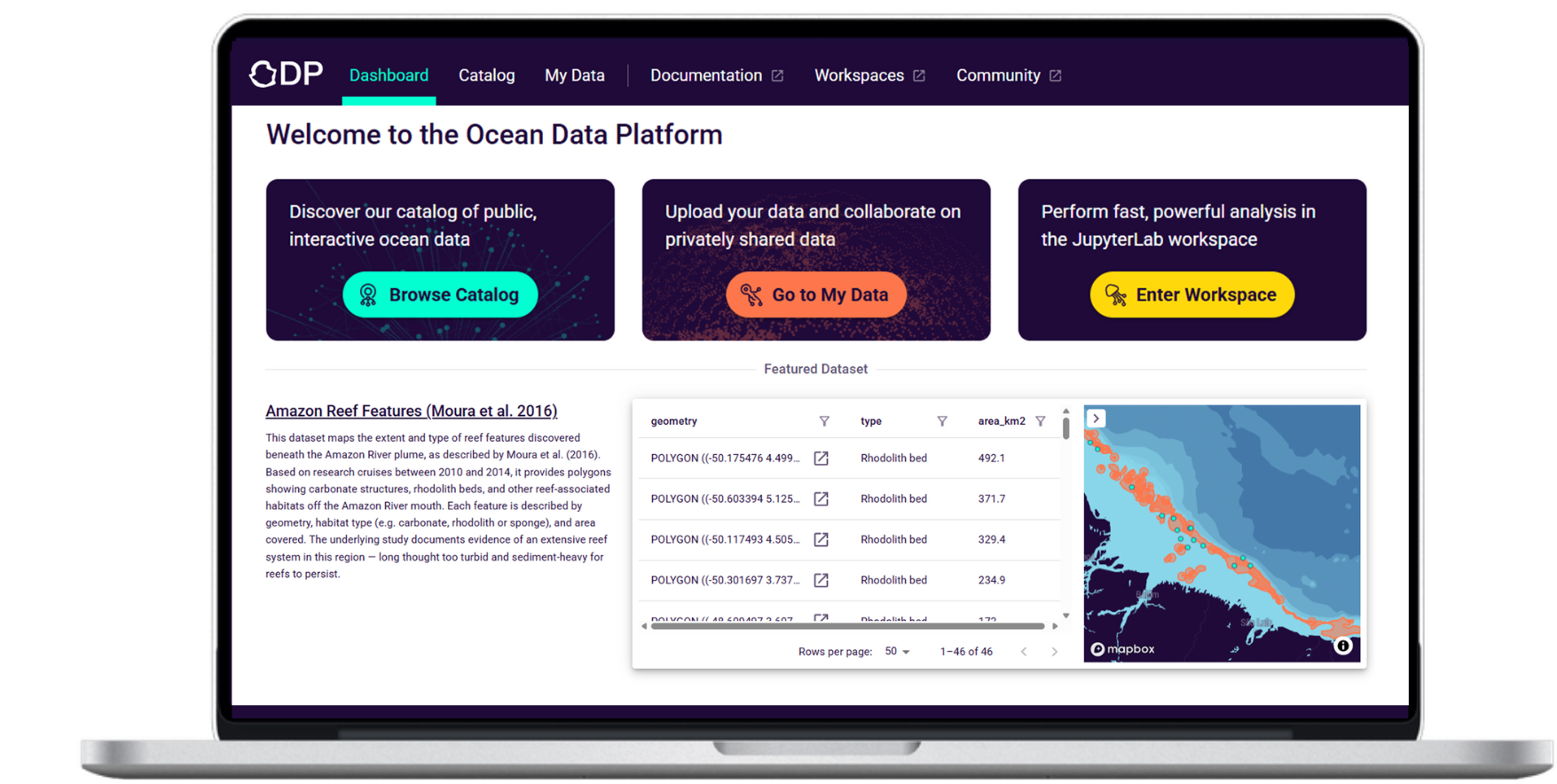

Unleashing the power of data for a healthier ocean

Everything an ocean data scientists or researcher needs
Ocean Data Platform Overview
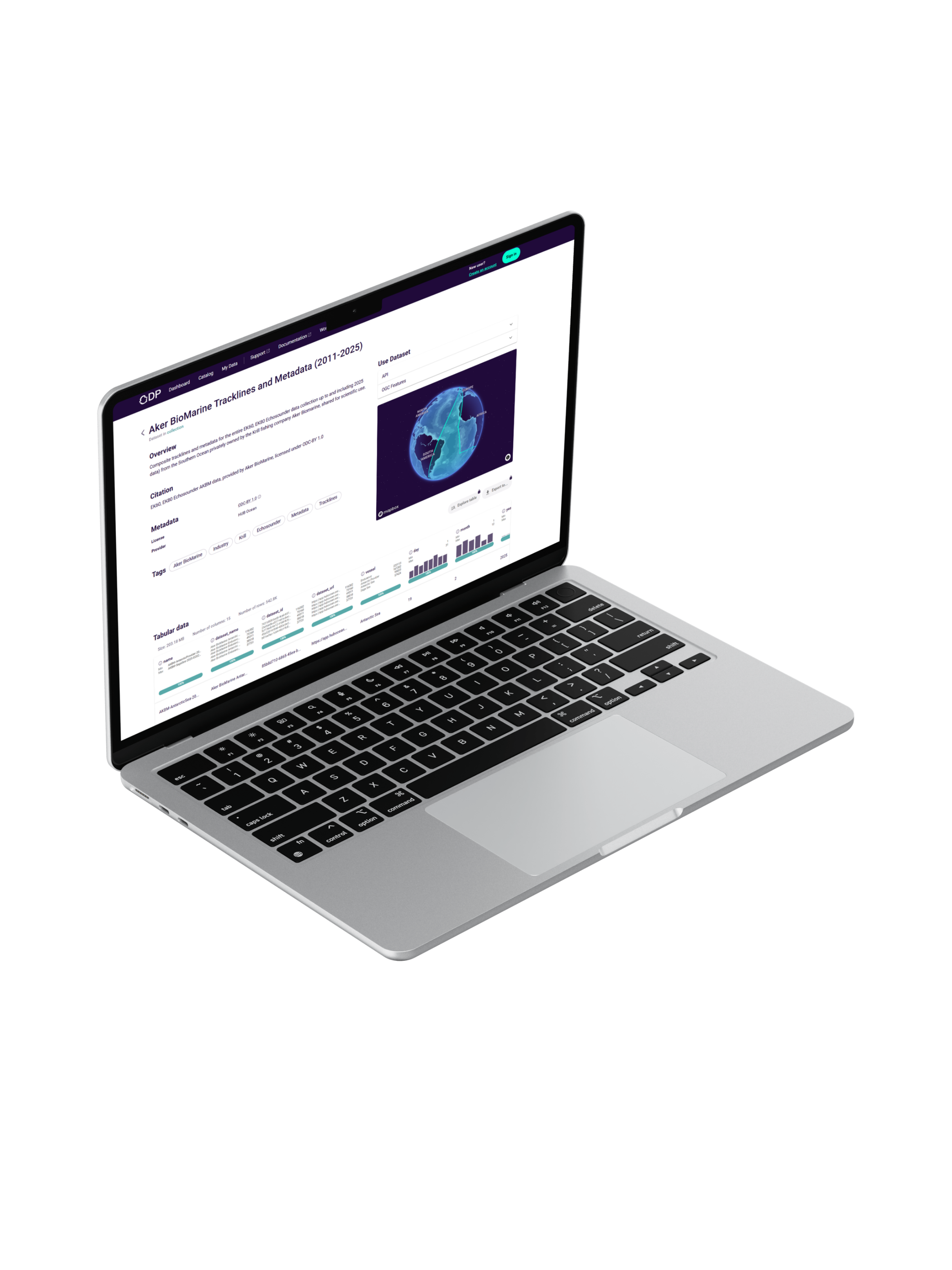
Open Data Catalog
Explore thousands of ocean, climate, and biodiversity datasets from trusted global sources - public, scientific, industrial. Search, filter, and visualize data instantly. Fully open. Updated continuously.
Cloud Workspace + Jupyter
Jupyter notebooks with scalable Dask compute are integrated directly with the catalog, letting you work with large datasets without downloading them locally. Plus, the bandwidth between the platform and workspaces is much higher than a home connection - presumably.
Private Data Space
You can upload private datasets and collaborate with colleagues, thanks to link based access. Then publish results to the public catalog just as easily — complete with DOIs. Lineage, and FAIR data governance are built in
“The Ocean Data Platform definitely accelerates things. It's just a lot faster if I can run my code directly where the data is located at the server. So, it definitely speeds up things by, instead of weeks, it's just an hour or so that things take to compute.”
— Sebastian Menze, Institute of Marine ResearchSebastian and his colleagues develop and apply data‑analysis and machine learning methods using acoustic data from krill fishing vessels to detect and map Antarctic predators and biodiversity hotspots in the Southern Ocean. Read their latest blog, complete with links to their data collection and notebook.
WHAT’S IN THE CATALOG
The Datasets researchers actually search for
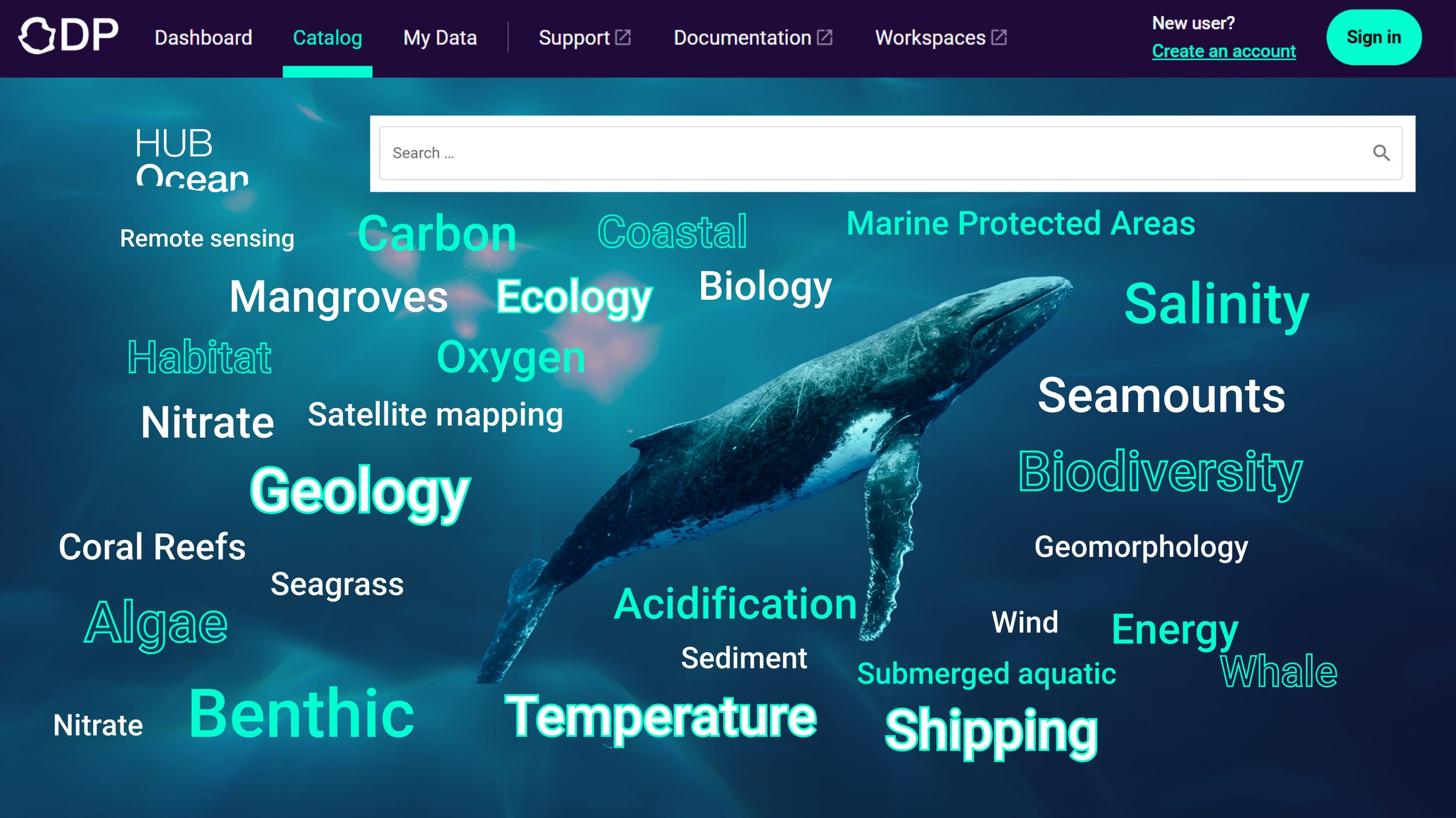
The Ocean Data Platform brings together all major types of ocean data in one place — physical oceanography data including, CTD casts, and sea surface temperature; biogeochemical data including ocean pH, CO₂, and dissolved oxygen; biological and biodiversity data including ocean chlorophyll, zooplankton, and whale tracking; seafloor and bathymetry data; human activity data including AIS vessel, marine traffic data; and sea ice and polar data
You'll find well-known public sources like the World Ocean Atlas, World Ocean Database, Copernicus Marine, and GEBCO bathymetry data — alongside unique and hard-to-find datasets from industry and research partners, including underwater acoustic data from Aker BioMarine, seismic and subsurface data from TGS, and many more datasets you won't find anywhere else.
“The platform is designed to solve several critical challenges in ocean data management: ocean data stored in multiple sources and formats, difficulty in accessing and analyzing large-scale ocean datasets, need for standardized data processing and quality control, or limited collaboration opportunities between researchers and organizations.”
— Brenda Varguez, Ocean Data Platform userTHE PLATFORM’S TOP FEATURES
Find & Filter Oceanographic Datasets Easily & Efficiently
Discover and explore a unified catalog of ocean, climate, and biodiversity datasets. Easily filter by variable, region, and time range using intuitive table tools, or visualize spatial coverage directly on the map powered by geospatial services and vector tiling. Seamlessly bring datasets into your workspace or download them in formats like NetCDF, CSV, or GeoJSON.
Sharing marine data shouldn’t be difficult. HUB Ocean makes it seamless to upload, standardize, version, and collaboratively analyze datasets. Whatever ocean research or analysis project it is, teams can securely manage, evolve, and co‑develop datasets all in one place.
Upload Your Private Data & Collaborate with Your Team
Leverage the Workspace & Save Time on Analysis
The Ocean Data Platform gives ocean researchers a cloud Jupyter workspace with scalable Dask compute — query sea surface temperature, bathymetry, mangroves, coral reefs or any other dataset directly in the cloud catalog, analyse in Python or R, and share fully reproducible workflows with your team. No downloads, no setup, no switching tools. It’s fast, efficient and optimized for AI-enhanced ocean analytics as well.
Publish your Data in the Public Catalog
Publish your oceanographic datasets on the Ocean Data Platform and they're indexed on Google, assigned a DOI, and discoverable by researchers worldwide. Of course, you could just use the Ocean Data Platform at the end as a publishing step. But once you realise the catalog, cloud workspace, and SDKs are all right there, you might end up wondering why you didn’t integrate the platform earlier in your worklow.

Learn, Share, Collaborate

We share notebook examples of how to work with the Ocean Data Platform using different SDKs.

We share tutorial videos on our YouTube channel, as well as recordings of recent webinars.
We have a growing and vibrant community on Slack - where users come together to learn.
Watch our Latest Webinars, Tutorials and Live Demos
We share tutorial videos on our YouTube channel, as well as recordings of recent webinars.
OUR MISSION
About HUB Ocean: A Non-Profit Mission for Ocean Data
HUB Ocean is a non-profit on a mission to make ocean data — from sea surface temperature and marine biodiversity records to bathymetry and more — open, accessible, and actionable for researchers, governments, and industries worldwide. Born from a collaboration between the World Economic Forum and the Aker Group, and headquartered in Oslo, Norway, we built the Ocean Data Platform to unleash the power of ocean data for ocean health.
We lead the Ocean Data Action Coalition for the Ocean Panel, support the UN Ocean Decade, and work with 27+ strategic partners to ensure that critical oceanographic data doesn't stay locked in silos — because better ocean data means better ocean science, better policy, and a better chance of protecting 30% of the ocean by 2030.

OUR MISSION
Data for a Healthier Ocean
We collaborate with companies across shipping, seafood, offshore energy, aquaculture, and finance sectors to unlock industrial ocean data for the scientific for scientific use and provide better data to these sectors for improved decision-making. By improving access to high‑quality ocean, we help industries reduce environmental impacts, increase transparency, and innovate for a more resilient ocean. Through these partnerships, we aim to accelerate responsible operations, strengthen regulatory alignment, and enable truly sustainable ocean‑dependent industries
Accelerating Global 30×30 and Marine Protection
Science is clear: we must protect 30% of the ocean by 2030. Today less than 10% is protected. The gap between ambition and action is partly a data problem— and HUB Ocean exists to help close it. We advance global efforts to protect 30% of the ocean by 2030 (30×30) by improving access to data that supports the creation, management, and monitoring of marine protected areas (MPAs) and other effective area‑based conservation measures. Through our ocean data platform, we help governments, NGOs, researchers, and local communities make informed decisions that strengthen conservation outcomes
“We hope to inspire other companies to get involved in sharing data to support SDG14. The Ocean is our working environment and taking care of it is not only a priority, but our way to contribute to sustainable seas.”
- Sandy Spørck, TGS
Latest news
We Want to Work With You

Science and Research Institutions
We partner with leading research institutions worldwide, serving them with a performant platform with strong data and collaborative capabilities.

Governance, Funders, Vessels, NGOs
Protecting and Restoring our ocean is an "‘all of society’ effort. We are always looking for new partners to join forces with.

Ocean Industries and Financial Institutions
We partner with forward-thinking companies contributing ocean data and with organizations seeking better ocean data for decision-making.
Ready to Start?
Access the Ocean Data Platform now and transform how you work with ocean data
HUB Ocean is Supported by:
Accenture
Akastor
Aker Biomarine
Aker Solutions
Aker Horizons
Aker Asa
Aker BP
Aker Qrill Company
BAHR
Cognite
DNB
Mercuria
Microsoft
Solstad Offshore
Accenture Akastor Aker Biomarine Aker Solutions Aker Horizons Aker Asa Aker BP Aker Qrill Company BAHR Cognite DNB Mercuria Microsoft Solstad Offshore
